One stock can't tell edge from luck.
At 55% accuracy, one name's noise swamps the signal. There isn't enough evidence in a single stock to know whether you have an edge at all.
Single-security signal platforms make it easy to evaluate and backtest ideas in isolation. The harder research problem is deciding whether noisy, regime-dependent signals still hold together in a broader portfolio context.
StrategyNet is software for systematic research and portfolio analysis. It ingests real-time data across US exchanges, futures, options, FX, crypto, indices, prediction markets, and financial statements, then helps users organize signal evidence into factors, compare candidate scenarios, and monitor exposures. Outputs are analytical inputs for review, not recommendations or instructions to trade.
Single-symbol tools make one idea easy to test. But signals don't work in isolation — portfolios do, and that is where correlation, crowding, and regime decide the outcome.
At 55% accuracy, one name's noise swamps the signal. There isn't enough evidence in a single stock to know whether you have an edge at all.
A faint edge separates from noise across hundreds of uncorrelated positions, never on a single trade. Diversification is what turns 55% into a return.
Search history for the strategy that fit best and you find noise dressed as edge — what wins a backtest rarely survives live.
Correlation, crowding, and regime only appear once positions interact. A one-name backtest never sees them, so its results rarely hold up in a real book.
Rechecking factor drift by hand after every macro surprise doesn't scale, and trading on stale conviction is costly.
Most teams stitch evaluation, optimization, and execution together with scripts and one-off spreadsheets. The result is slow, brittle, and hard to audit.
Every studio below maps to one stage of the same pipeline, so a raw idea turns into a reviewed, risk-adjusted allocation with an audit trail behind it.
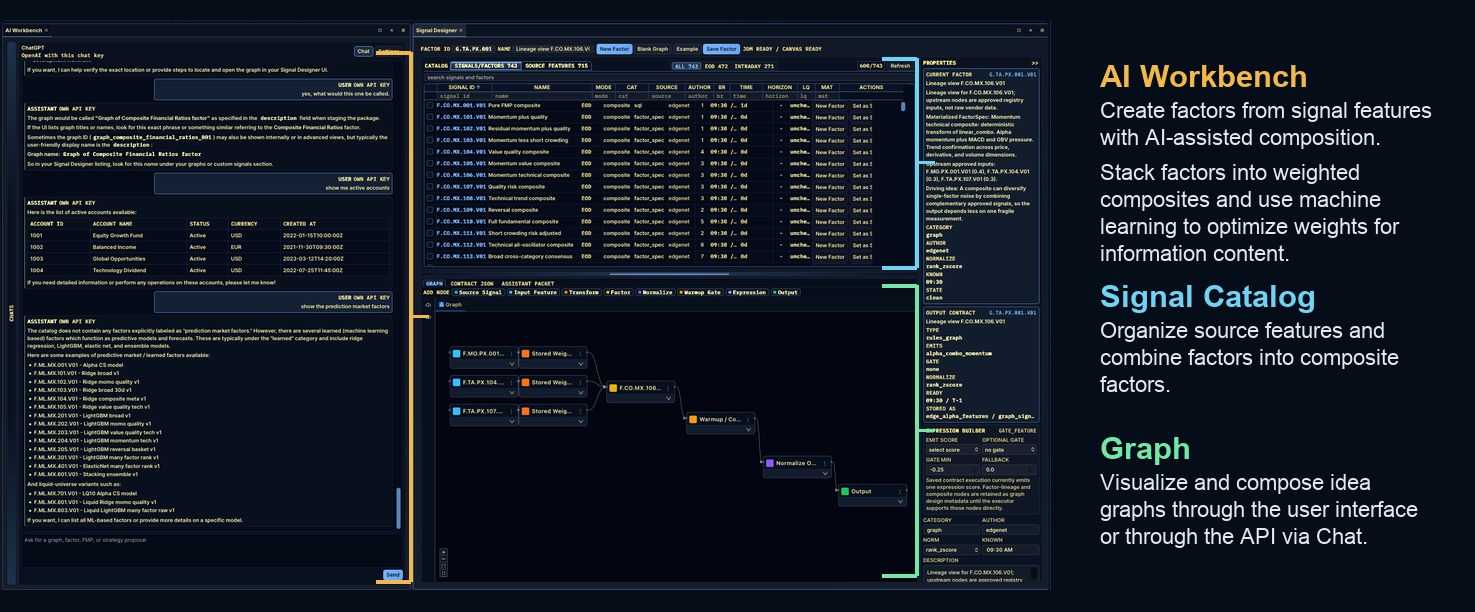
Create unique alpha from inputs such as earnings, news, prediction markets, and market data.
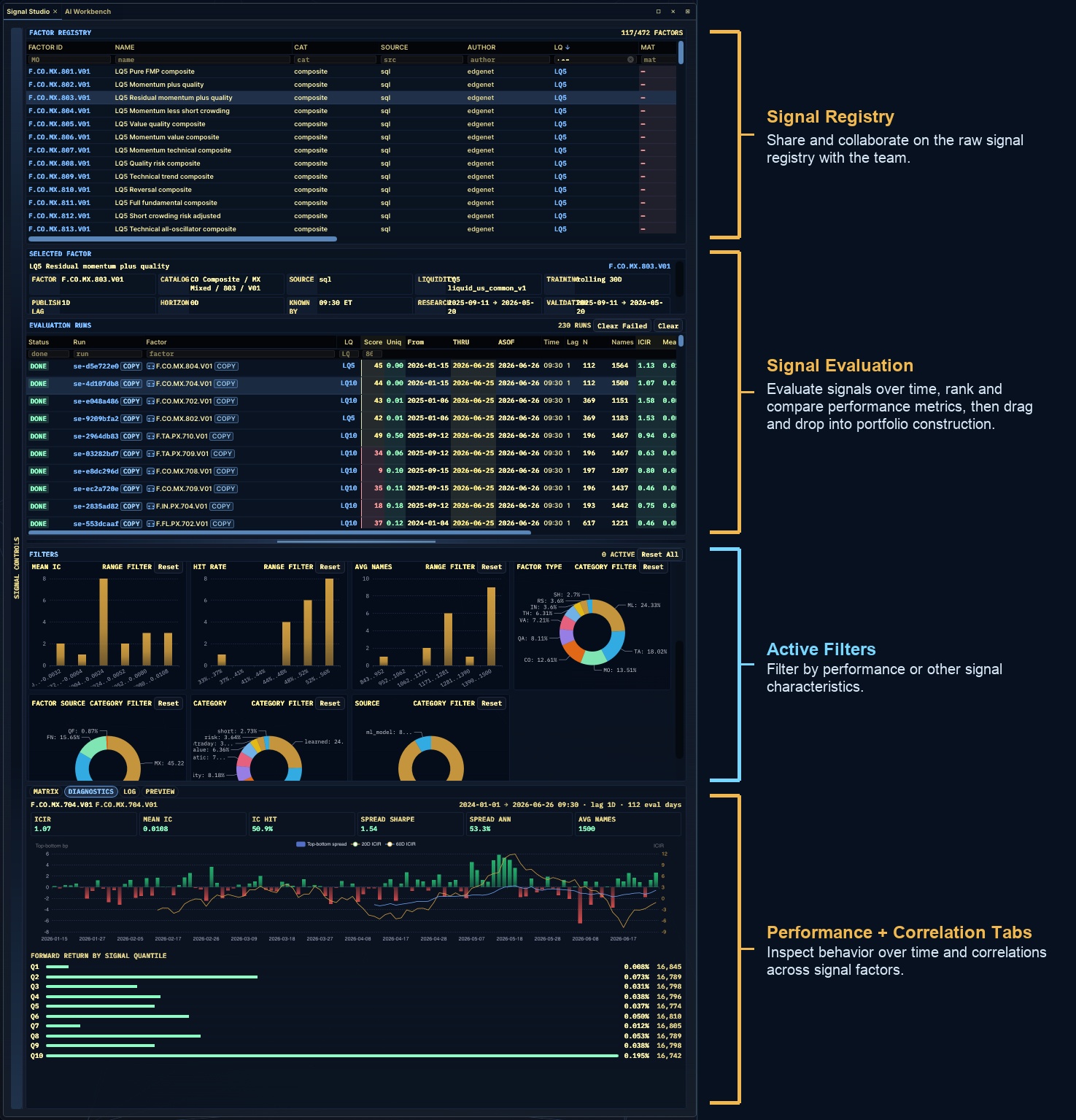
Evaluate, compare, and rank signals that express an investment idea. Compare information content ratios, hit rates, and the spread between positions expected to benefit from the idea and those expected to lag if it plays out.
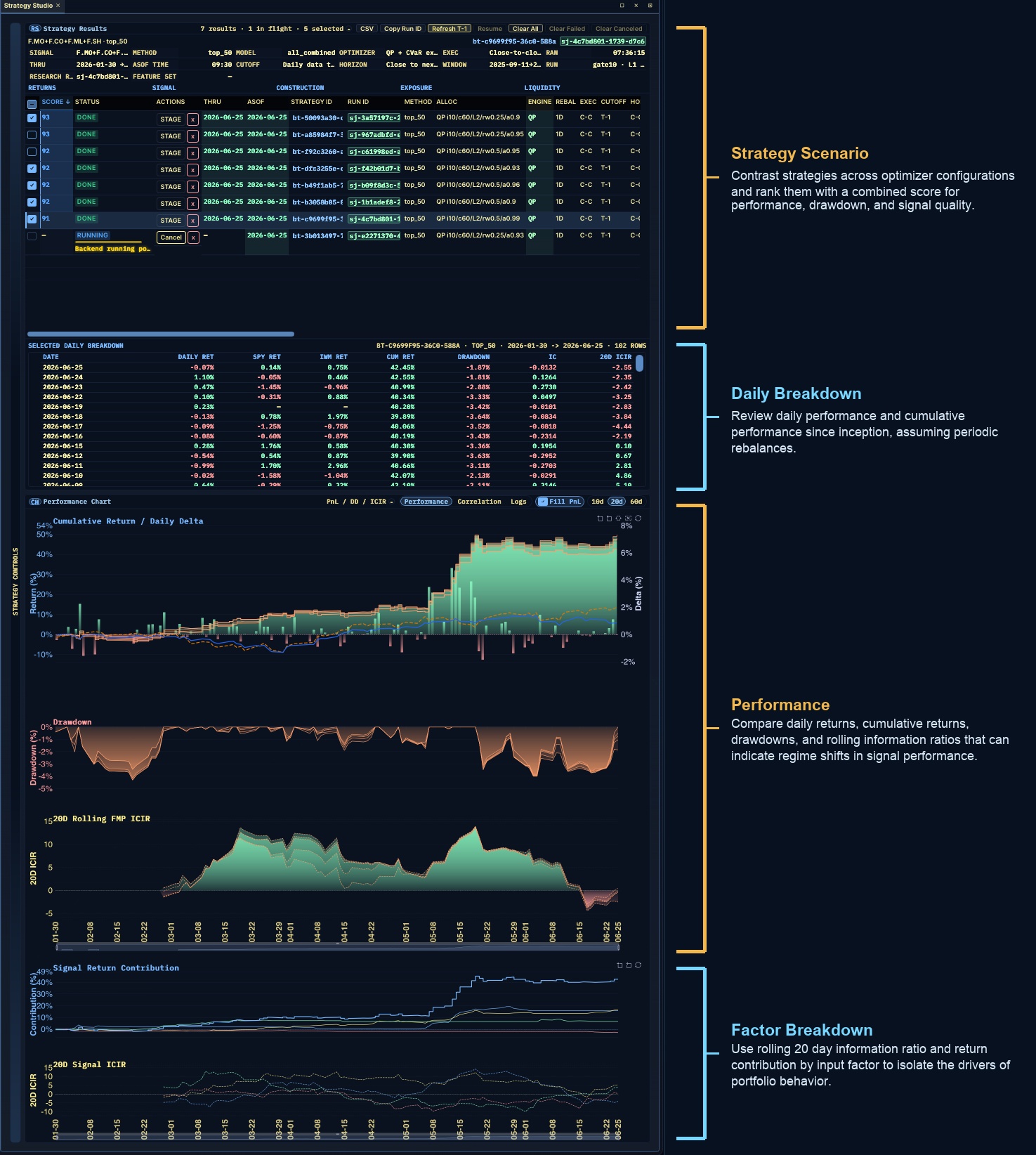
Assemble multiple ideas in one framework, then optimize baskets that turn idea factors into a single risk-adjusted portfolio plan.
Stage, execute, and monitor multiple strategies through an execution API. Alpaca is currently supported.
AI Workbench helps transform source features, stacked factors, and optimizer output into reusable factor graphs for systematic research.
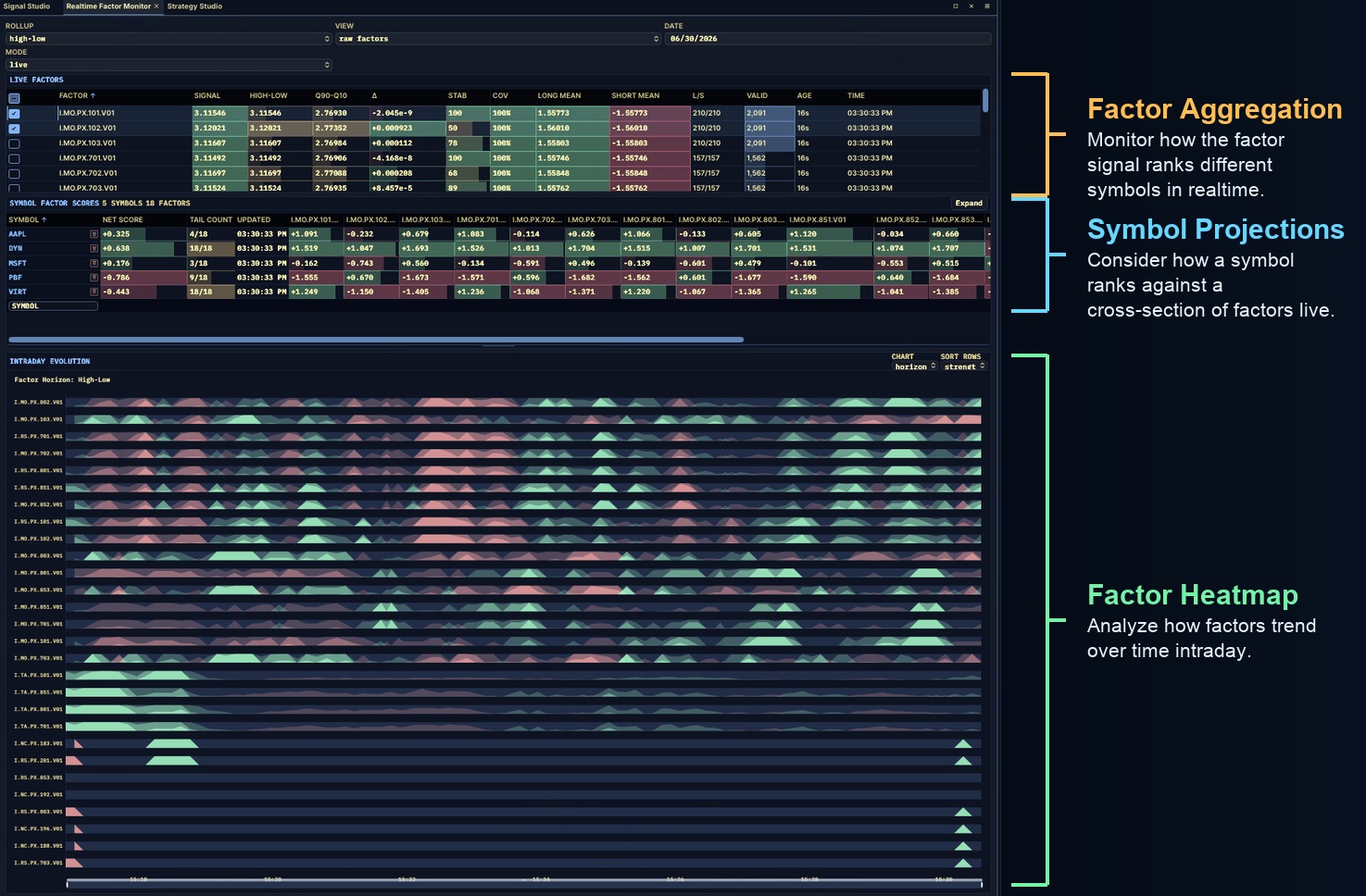
Track live factor ranks, symbol projections, and intraday factor movement before sending a candidate signal into deeper evaluation.
Signal Studio is the research surface for comparing candidate factors, reviewing evaluation runs, and checking whether an idea has enough statistical structure to justify portfolio construction.
Strategy Studio brings scenario generation, optimizer configuration, daily performance inspection, and factor attribution into one review surface.
Start with Pro, move to Pro Plus as your workflow goes live and scheduled, or talk to us about a Team or Desk deployment.
Core research, factor construction, and portfolio testing.
Scheduled research, optimization, and integration workflows.
Institutional workflow layer.
strategynet.xyz is a research system from a team of experienced quantitative engineers. It is designed to replicate professional workflows: extract signals, distill them into portable alpha or factors, use those factors to drive optimization, and connect the results to systematic analysis and portfolio monitoring.
Equities, ETFs, futures, options, FX, crypto, indices, and prediction markets feed the same factor and optimization framework instead of separate tools.
AI Workbench helps compose and weight factor graphs. You still review every scenario before it reaches an execution API.
Strategies that clear evaluation can be staged straight to a connected execution API, closing the loop between research and the blotter.
Authenticator-app two-factor authentication, scoped API keys, and session-based access controls ship with every paid tier.
What teams evaluating StrategyNet ask us most often.
No. StrategyNet is research and portfolio-analysis software. It organizes signal evidence into factors and produces candidate scenarios for your own review. Outputs are analytical, not personalized investment advice, and you are responsible for your own investment decisions.
Real-time and historical data across US equities, ETFs, futures, options, FX, crypto, major indices, prediction markets, and financial statements, feeding one shared factor model.
No. Every studio is point-and-click. Teams that want programmatic control can also compose factors and automate workflows through the API and Chat interface.
Authenticator-app two-factor authentication, scoped API keys, and session-based access controls are available from the Pro tier up.
Pro covers core research and daily factor tracking. Pro Plus adds live tracking, intraday strategies, and scheduled automation. Team/Desk adds multi-seat workflows, audit logs, and custom data integration — talk to us to scope it.
No. StrategyNet can stage candidate strategies to a connected execution API such as Alpaca, but you review and control what is sent. StrategyNet does not take custody of assets or manage your account on a discretionary basis.
Start on Pro today, or talk to us about a Team or Desk deployment scoped to your data and workflow.
StrategyNet can generate candidate trade scenarios based on selected factors, constraints, and portfolio data. These scenarios are model outputs for analysis only. They are not recommendations, investment advice, or instructions to trade. You are responsible for independently reviewing all outputs before taking any action.